
Cross-match ZTF BTS and NGC#
In this notebook, we demonstrate how to cross-match Zwicky Transient Facility (ZTF) Bright Transient Survey (BTS) and New General Catalogue (NGC) using LSDB.
We are using the original survey datasets, as presented by the original survey providers, instead of catalogs that have already been converted to HATS format.
[1]:
# Install astroquery, comment this line if you already have it
%pip install --quiet astroquery
Note: you may need to restart the kernel to use updated packages.
[2]:
import lsdb
import matplotlib.pyplot as plt
import numpy as np
import pandas as pd
from astropy.coordinates import SkyCoord
from astropy.table import Table
from astroquery.vizier import Vizier
from dask.distributed import Client
1. Download data#
1.1. Download ZTF BTS and convert coordinates to degrees#
We download the ZTF BTS data via HTTP, but must first convert the coordinates into degrees before loading as LSDB catalogs.
Of course ZTF looks much deeper than NGC galaxies from 19th century, so we filter ZTF transients by redshift.
[3]:
%%time

ztf_bts = pd.read_csv(
    "http://sites.astro.caltech.edu/ztf/bts/explorer.php?format=csv",
    na_values="-",
)
ztf_bts = ztf_bts.query("redshift < 0.01")
coord = SkyCoord(ztf_bts["RA"], ztf_bts["Dec"], unit=("hourangle", "deg"))
ztf_bts["ra_deg"], ztf_bts["dec_deg"] = coord.ra.deg, coord.dec.deg
ztf_bts
CPU times: user 61.6 ms, sys: 18.5 ms, total: 80.1 ms
Wall time: 3.42 s
[3]:
| ZTFID | IAUID | RA | Dec | peakt | peakfilt | peakmag | peakabs | duration | rise | fade | type | redshift | b | A_V | ra_deg | dec_deg | |
|---|---|---|---|---|---|---|---|---|---|---|---|---|---|---|---|---|---|
| 228 | ZTF18acbwaxk | SN2018hna | 12:26:12.08 | +58:18:50.8 | 503.03 | r | 13.9583 | -16.13 | 61.205 | 48.696 | 12.509 | SN II | 0.00240 | 58.502394 | 0.031 | 186.550333 | 58.314111 |
| 232 | ZTF18acbvgqw | SN2018htt | 03:06:02.90 | -15:36:41.7 | 441.75 | g | 13.9113 | -19.07 | 25.333 | 10.316 | 15.017 | SN Ia | 0.00867 | -56.742964 | 0.101 | 46.512083 | -15.611583 |
| ... | ... | ... | ... | ... | ... | ... | ... | ... | ... | ... | ... | ... | ... | ... | ... | ... | ... |
| 9447 | ZTF25aaugeio | SN2025mvn | 13:13:27.85 | +36:35:11.6 | 2850.78 | r | 15.3985 | -15.11 | >25.08 | >15.06 | >10.02 | SN II | 0.00291 | 79.453892 | 0.032 | 198.366042 | 36.586556 |
| 9477 | ZTF25aauvber | SN2025ngs | 15:35:16.68 | +30:51:55.7 | 2847.77 | r | 15.5015 | -16.73 | >19.561 | 6.481 | >13.08 | SN II | 0.00630 | 54.177709 | 0.078 | 233.819500 | 30.865472 |
108 rows × 17 columns
1.2. Download NGC with astroquery#
Please install astroquery first with pip install astroquery or conda install -c conda-forge astroquery.
[4]:
%%time

vizier = Vizier(row_limit=50_000)
tables = vizier.get_catalogs("VII/118/ngc2000")
ngc = tables[0].to_pandas()
coord = SkyCoord(ngc["RAB2000"], ngc["DEB2000"], unit=("hourangle", "deg"))
ngc["ra_deg"], ngc["dec_deg"] = coord.ra.deg, coord.dec.deg
ngc
CPU times: user 685 ms, sys: 15.9 ms, total: 701 ms
Wall time: 702 ms
[4]:
| Name | Type | RAB2000 | DEB2000 | Source | Const | l_size | size | mag | n_mag | Desc | ra_deg | dec_deg | |
|---|---|---|---|---|---|---|---|---|---|---|---|---|---|
| 0 | I5370 | Gx | 00 00.1 | +32 45 | m | And | 0.7 | 15.0 | p | pB, S, R, stell N | 0.025 | 32.750000 | |
| 1 | I5371 | 00 00.2 | +32 49 | d | And | NaN | NaN | F, vS, *15 att | 0.050 | 32.816667 | |||
| ... | ... | ... | ... | ... | ... | ... | ... | ... | ... | ... | ... | ... | ... |
| 13224 | 7807 | Gx | 23 59.6 | -18 51 | c | Cet | 1.0 | NaN | eF, pS, iF | 359.900 | -18.850000 | ||
| 13225 | I5369 | 23 59.8 | +32 41 | d | And | NaN | NaN | F, S, R, N | 359.950 | 32.683333 |
13226 rows × 13 columns
2. Plan cross-match job#
LSDB is built upon Dask and can be used with Dask distributed cluster. In this cell we just plan computations and do not actually run them.
[5]:
%%time

matched_catalog = lsdb.crossmatch(
    ztf_bts,
    ngc,
    radius_arcsec=1200,
    ra_column="ra_deg",
    dec_column="dec_deg",
    suffixes=("_ztf", "_ngc"),
)
matched_catalog
CPU times: user 3.64 s, sys: 287 ms, total: 3.92 s
Wall time: 3.85 s
[5]:
| ZTFID_ztf | IAUID_ztf | RA_ztf | Dec_ztf | peakt_ztf | peakfilt_ztf | peakmag_ztf | peakabs_ztf | duration_ztf | rise_ztf | fade_ztf | type_ztf | redshift_ztf | b_ztf | A_V_ztf | ra_deg_ztf | dec_deg_ztf | Name_ngc | Type_ngc | RAB2000_ngc | DEB2000_ngc | Source_ngc | Const_ngc | l_size_ngc | size_ngc | mag_ngc | n_mag_ngc | Desc_ngc | ra_deg_ngc | dec_deg_ngc | _dist_arcsec | |
|---|---|---|---|---|---|---|---|---|---|---|---|---|---|---|---|---|---|---|---|---|---|---|---|---|---|---|---|---|---|---|---|
| npartitions=10 | |||||||||||||||||||||||||||||||
| Order: 0, Pixel: 0 | string[pyarrow] | string[pyarrow] | string[pyarrow] | string[pyarrow] | double[pyarrow] | string[pyarrow] | double[pyarrow] | double[pyarrow] | string[pyarrow] | string[pyarrow] | string[pyarrow] | string[pyarrow] | double[pyarrow] | double[pyarrow] | double[pyarrow] | double[pyarrow] | double[pyarrow] | string[pyarrow] | string[pyarrow] | string[pyarrow] | string[pyarrow] | string[pyarrow] | string[pyarrow] | string[pyarrow] | float[pyarrow] | float[pyarrow] | string[pyarrow] | string[pyarrow] | double[pyarrow] | double[pyarrow] | double[pyarrow] |
| Order: 0, Pixel: 1 | ... | ... | ... | ... | ... | ... | ... | ... | ... | ... | ... | ... | ... | ... | ... | ... | ... | ... | ... | ... | ... | ... | ... | ... | ... | ... | ... | ... | ... | ... | ... |
| ... | ... | ... | ... | ... | ... | ... | ... | ... | ... | ... | ... | ... | ... | ... | ... | ... | ... | ... | ... | ... | ... | ... | ... | ... | ... | ... | ... | ... | ... | ... | ... |
| Order: 7, Pixel: 161010 | ... | ... | ... | ... | ... | ... | ... | ... | ... | ... | ... | ... | ... | ... | ... | ... | ... | ... | ... | ... | ... | ... | ... | ... | ... | ... | ... | ... | ... | ... | ... |
| Order: 7, Pixel: 179663 | ... | ... | ... | ... | ... | ... | ... | ... | ... | ... | ... | ... | ... | ... | ... | ... | ... | ... | ... | ... | ... | ... | ... | ... | ... | ... | ... | ... | ... | ... | ... |
3. Run LSDB pipeline#
We create a dask client to run the crossmatch in parallel.
Additional Help
For additional information on dask client creation, please refer to the official Dask documentation and our Dask cluster configuration page for LSDB-specific tips. Note that dask also provides its own best practices, which may also be useful to consult.
[6]:
%%time

# Create default local cluster
with Client():
    matched_df = matched_catalog.compute()

# Let's output transient name, NGC name and angular distance between them
matched_df = matched_df[["IAUID_ztf", "Name_ngc", "_dist_arcsec", "RA_ztf", "Dec_ztf"]].sort_values(
    by=["_dist_arcsec"]
)
matched_df
CPU times: user 342 ms, sys: 93.9 ms, total: 436 ms
Wall time: 3.83 s
[6]:
| IAUID_ztf | Name_ngc | _dist_arcsec | RA_ztf | Dec_ztf | |
|---|---|---|---|---|---|
| _healpix_29 | |||||
| 1957242016251976064 | SN2022xxf | 3705 | 2.985601 | 11:30:05.93 | +09:16:57.2 |
| 1827616204711960889 | SN2024jlf | 5690 | 6.309787 | 14:37:42.32 | +02:17:04.1 |
| ... | ... | ... | ... | ... | ... |
| 190562289935449883 | AT2020aabh | 206 | 1081.99822 | 00:39:30.06 | +40:31:00.8 |
| 184639843781841134 | AT2022qpg | 224 | 1193.179125 | 00:44:20.78 | +41:23:10.8 |
84 rows × 5 columns
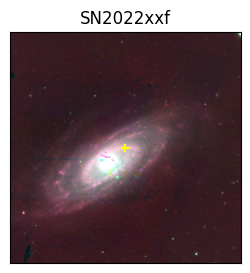
We may have some false matches here, because NGC is too shallow for this task. However, if we sort the table by the cross-match distance, we can see the first one is a supernova (SN2022xxf) in the nearby galaxy NGC 3705.
4. Make some plot#
This part is not related to LSDB and adopted from PanSTARRS image this tutorial.
Now let’s download host galaxy image from the PanSTARRS survey and plot it out (with SN location in the middle and marked with a “+”)
[7]:
def getimages(ra, dec, size=240, filters="grizy"):
    """Query ps1filenames.py service to get a list of images

    ra, dec = position in degrees
    size = image size in pixels (0.25 arcsec/pixel)
    filters = string with filters to include
    Returns a table with the results
    """

    service = "https://ps1images.stsci.edu/cgi-bin/ps1filenames.py"
    url = ("{service}?ra={ra}&dec={dec}&size={size}&format=fits" "&filters={filters}").format(**locals())
    table = Table.read(url, format="ascii")
    return table


def get_ps1_image(url, size=240):
    """
    size: pixel number for 0.25 arcsec/pixel
    """
    from PIL import Image
    import requests
    from io import BytesIO

    try:
        r = requests.get(url)
        im = Image.open(BytesIO(r.content))
    except:
        print("Can't get ps1 image")
        im = None
    return im
[8]:
c = SkyCoord(
    matched_df["RA_ztf"].to_numpy()[0], matched_df["Dec_ztf"].to_numpy()[0], unit=("hourangle", "deg")
)
ra = c.ra.degree
dec = c.dec.degree
oid = matched_df["IAUID_ztf"].to_numpy()[0]
table = getimages(ra, dec, size=1200, filters="grizy")
url = (
    "https://ps1images.stsci.edu/cgi-bin/fitscut.cgi?"
    "ra={}&dec={}&size=1200&format=jpg&red={}&green={}&blue={}"
).format(ra, dec, table["filename"][0], table["filename"][1], table["filename"][2])
im = get_ps1_image(url)
fig, ax = plt.subplots(figsize=(7, 3))
if im is not None:
    ax.imshow(im)
    ax.set_xticks([])
    ax.set_yticks([])
    ax.scatter(np.average(plt.xlim()), np.average(plt.ylim()), marker="+", color="yellow")
    ax.set_title(oid)
    plt.show()
About#
Authors: Konstantin Malanchev, Mi Dai
Last updated on: Oct 27, 2025
If you use lsdb for published research, please cite following instructions.